Oily roots but dry ends: how to care for both
6 min read Care know-how Updated 2 September 2026
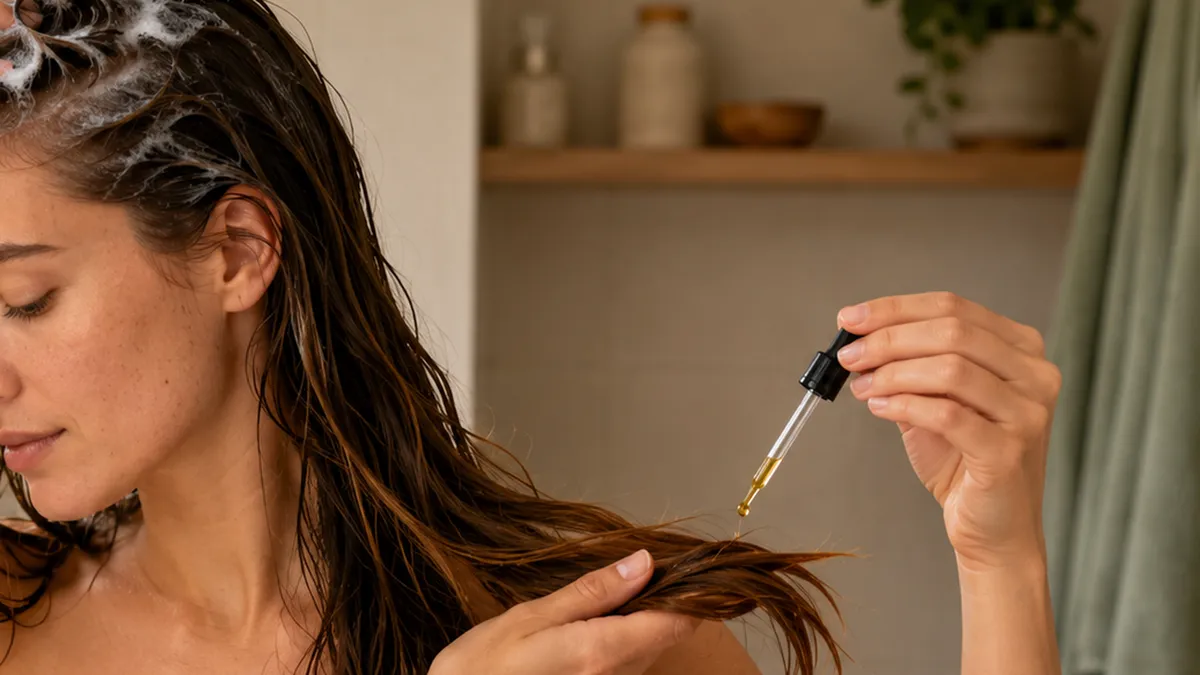
Oily roots and dry ends are not a contradiction: the scalp produces sebum while older lengths turn drier through friction, colour, and heat. The solution is a zoned routine, that is cleansing where sebum is made, and care where the fibre needs it. A single product for both at once can hardly work, because roots and ends want exactly the opposite.
Why do roots and ends behave differently?
Sebum is produced solely at the scalp. On short hair it spreads almost by itself down to the ends, on medium-length or long hair it often only makes it a few centimetres. So the roots are supplied with oil and quickly look greasy, while the lengths go without.
Then there is the age of the fibre. Your ends are the oldest part of the hair and have months or years of blow-drying, flat ironing, colouring, and everyday friction behind them. They are more porous, lose moisture faster, and therefore look dull and dry, exactly when the roots are already shining again. So the roots need cleansing and balance, the ends need moisture and protection.
The myth of "scalp training"
One stubborn piece of advice goes: frequent washing supposedly makes the scalp produce even more sebum, so you have to re-educate it by deliberately stretching your washes. That is not proven that way. How much sebum your scalp makes depends mainly on predisposition, hormones, and the season, not on a training plan.
What is true: a shampoo that is too aggressive or too hot can irritate the scalp briefly and dry out the lengths, which sharpens the contrast between oily roots and strawy ends. But you do not have to force yourself into a rigid washing rhythm. Wash when your roots need it, and use a mild, well-tolerated product for it. The goal is not to wash less often, but to wash correctly.
What does that mean at MONAT?
At MONAT we think about washing from the scalp and work in zones. The shampoo is there for the roots, where sebum and build-up sit. The care belongs in the lengths and ends, which are the oldest and most stressed. And for a scalp that tends towards build-up, there is a dedicated, mildly cleansing line instead of an aggressive anti-grease shampoo that would only dry out the ends further.
The zoned washing routine
The most important idea: shampoo is there for the scalp, care for the lengths. Anyone who consistently separates these already solves a large part of the problem.
Step 1 — Cleanse the scalp deliberately. Massage the shampoo only into the roots and scalp, where sebum and build-up sit. The lengths get clean enough all by themselves as you rinse, you do not have to lather them separately. For a scalp that gets oily fast or looks weighed down, the clarifying vinegar shampoo is a good choice: it cleanses the scalp with a noticeable freshness without drying out the lengths further. If you want the cleansing even more noticeable, you can use the clarifying vinegar rinse instead.
Step 2 — Care for the lengths and ends only. Apply conditioner or mask from about ear height downwards and deliberately leave out the roots. That way the dry ends get moisture without weighing down the roots. For noticeably dry lengths, a moisture base such as the Advanced Hydration System is suitable, and once or twice a week the Super Moisture Masque may replace the conditioner.
Step 3 — Seal the ends. Into towel-damp hair, apply a leave-in such as the Restore™ Leave-In Conditioner and, if needed, one to two drops of REJUVENIQE® on the lengths and ends only. Order and amount matter: moisture first, then oil to seal, sparingly, so that nothing is weighed down and the roots stay free. How much oil makes sense is shown in the guide on using hair oil properly.
As a starting rule: shampoo at the roots, care below the ears.
The version for fine hair
Fine hair looks flat at the roots especially fast, because even a little sebum lays the delicate strands together. At the same time it does not tolerate heavy care. Here zoning is doubly important:
- Keep the care deliberately light and apply it really only to the lower two-thirds of the lengths.
- At the roots, skip oil, mask, and rich conditioner entirely.
- Choose a light moisture base such as the Advanced Hydration System, which hydrates without burdening, so the volume at the crown is kept.
- Dry the roots upside down when blow-drying, so they do not lie flat.
Deep cleansing and dry shampoo
Even with a perfect routine, residue from styling, dry shampoo, and hard water builds up over time, especially at the roots. An occasional deep cleanse resets the scalp without stressing it long-term. The clarifying vinegar shampoo is suitable for that, or, for a more intensive scalp treatment on non-irritated skin, the scalp scrub, periodically, not with every wash. Details are in the purifying vinegar routine.
For the days between washes, dry shampoo is handy. The Champ™ freshens the dry roots on the second day and takes off excess shine, without exposing the dry lengths to water again. Important: dry shampoo goes only on dry hair, not on towel-damp hair. Use sparingly and brush out well, so that nothing builds up. Exactly how to do that is covered in how to use dry shampoo.
Common mistakes
- Putting rich care or a mask at the roots, this weighs down the roots and makes them look greasy faster.
- Oil at the crown instead of only on the ends, a few drops on the ends are plenty.
- Washing too hot, this irritates the scalp and dries out the lengths further.
- Forcing yourself into a rigid washing schedule because you want to re-educate the scalp, wash as needed, not by the calendar.
- Shampooing the lengths separately instead of keeping the shampoo to the scalp.
- Deep cleansing with every wash, periodically is enough, too often over-stresses the scalp.
Quick questions
Does frequent washing make the scalp oilier?
No, the idea that the scalp can be re-educated by stretching washes is not proven. How much sebum is produced is mainly a question of predisposition and hormones. What matters is not the frequency but a mild product and lukewarm water.
Where do I apply conditioner?
As a starting rule, below the ears, that is only on the lengths and ends, never at the roots. That way the dry ends get moisture while the roots are not weighed down and stay fresh longer.
How often does deep cleansing make sense?
Periodically, not with every wash. For most people an occasional cleanse with the clarifying vinegar shampoo is enough, a scalp scrub only now and then and only on non-irritated scalp.
Which MONAT system suits fine hair with oily roots?
A light moisture base such as the Advanced Hydration System in the lengths, combined with targeted scalp cleansing at the roots. That way the volume is kept without the dry ends missing out.
Does dry shampoo help with oily roots when the ends are dry?
As a bridge, yes: it absorbs oil at the roots without touching the ends. It does not replace a wash, though, and should not build up over several days in a row or it clogs the scalp.
Can I treat roots and ends differently?
That is exactly the point. Shampoo belongs on the scalp, conditioner and mask from ear level down. Spreading both over the whole head degreases the ends and weighs down the roots, which is the wrong way round.
Does washing the roots less often help?
With oily roots, rarely. The sebum keeps collecting, and the hair lies flat with it. It makes more sense to wash gently and regularly, and to leave the lengths largely alone instead.
Want to know exactly what your hair needs? Take the free hair analysis. In a few minutes you see your hair profile, and if you like, a personal consultant from our team puts together the zoned routine that fits.