Do Hair Masks Really Work? What They Can and Cannot Do
5 min read Ingredients Updated 2 September 2026
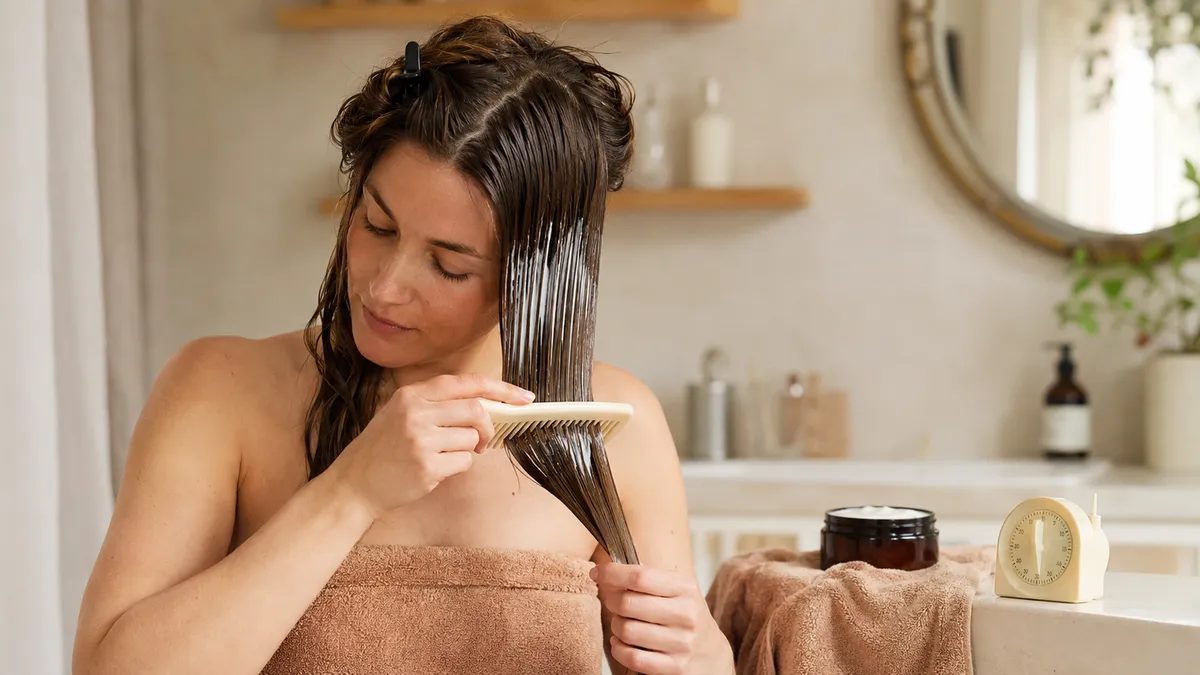
"Hair mask" is not a single, uniform product type. A moisture mask, an anti-frizz deep treatment, a bond leave-in cream, and a scalp treatment all do quite different jobs. Choosing the right one matters more than the longest possible leave-on time. That is exactly why so many masks disappoint: they simply were not made for what the hair needed at that moment. And whichever you pick, a mask improves the look and feel, but it does not permanently heal the hair fibre.
Mask, conditioner, or leave-in?
These three are often lumped together but work differently:
- Conditioner: lays a light film around the hair, makes it instantly combable, and is rinsed out after a short leave-on time. Everyday care for the surface.
- Mask and intensive treatment: more richly concentrated, stays in the hair longer, and cares more intensively. The extra boost for stressed lengths, rinsed out.
- Leave-in: stays in the hair, protects and cares through the day. Not a replacement for the conditioner, but an additional building block.
The key point: a mask sensibly replaces the conditioner on some days, but it does not have to always and for everyone. And not every mask penetrates deeper. What a product can do depends on its formula, not on the length of the leave-on time.
What does that mean at MONAT?
Instead of an all-in-one mask, MONAT covers the four jobs with four different products, and that is exactly where the difference lies. Moisture, smoothing, structure, and scalp are thought of separately, so that each treatment goes where it belongs: the moisture mask into the lengths, the leave-in stays in, the scalp treatment at the roots. Which product you need is decided by your goal, not by the reflex to simply reach for the richest one.
Choose by goal, not by "the richer, the better"
Before you reach for a mask, name the goal. The product type follows from that:
- Dryness and brittleness: the hair feels rough, flies away, is hard to comb. Here a moisture mask helps.
- Frizz and roughened structure: the hair looks frizzy and hard to tame, especially when there is moisture in the air. Then a smoothing deep treatment is the right choice.
- Weakened structure after chemistry or heat: the hair is over-stretched, breaks easily, feels rubbery. Here targeted bond and structure care counts more than plain moisture, more on that in the guide on bond repair.
- Scalp matter: tightness, flakes, or imbalance at the roots. That is the job of a scalp treatment, not a lengths mask.
Whether your hair needs moisture or structure can be read roughly from the fibre's behaviour, as an observation, not a diagnosis: if you gently pull a wet strand apart and it snaps almost immediately, moisture is more likely missing. If it stretches far and stays slack, that suggests missing structure. A reliable read comes from the free hair analysis or a professional. More on that in the protein and moisture balance.
MONAT treatments compared
MONAT covers the four jobs with different products:
- Super Moisture Masque: the light moisture mask for fine to medium, dry hair. Adds noticeable moisture without weighing down the lengths.
- Replenish™ Masque: the richer intensive treatment for thicker, very dry, or stressed hair that can take more and needs more.
- Smoothing Anti-Frizz™ Deep Conditioner: the smoothing deep treatment against frizz and roughened structure, when manageability and suppleness are the priority.
- Bond IQ™ Peptide Therapy Leave-In Cream: a leave-in for structurally stressed hair that stays in and cares and protects through the day.
- Scalp Comfort™ Balancing Scalp Treatment: the targeted treatment for the scalp matter, it belongs at the roots, not in the lengths.
The logic behind it: moisture masks go into the lengths and ends, the leave-in stays in, the scalp treatment at the roots. Which product suits you is decided by your goal from the section above.
Exact application principles
Which zone? Moisture and smoothing masks belong in the mid-lengths and ends, where the hair is oldest and most stressed. The roots need no mask, otherwise they get oily faster. A scalp treatment, on the other hand, is applied specifically at the roots, not in the lengths.
How much? A hazelnut to walnut-sized amount is enough for most lengths. More product does not care better, it only weighs down. Spread it evenly with a wide-tooth comb.
Before or after the conditioner? Usually the mask replaces the conditioner on the day you use it, layering both is rarely needed. A leave-in, by contrast, only goes into towel-damp hair after rinsing.
Leave-on time. As long as the product states, usually a few minutes. Longer is rarely better, and leaving rinse-out masks in overnight does nothing for most formulas. Then rinse thoroughly, cool if you like. Residue makes the hair look stringy.
How often?
The frequency depends on the condition, not the calendar:
- Fine, barely stressed hair: a moisture mask is often enough every one to two weeks, more often weighs it down.
- Thick, dry, or stressed hair: once or twice a week it can be the richer mask.
- Structure and bond care: use it in a targeted, measured way, not daily. Over-stretched hair needs recovery, not constant stress.
- Leave-in: may be used after every wash if needed, dosed sparingly.
Watch for the signs of over-care: if the hair feels flat, weighed down, stringy, or waxy, you are masking too often or too richly. Then better skip a wash.
Common mistakes
- Treating every mask as the same: a moisture mask does not solve a frizz problem, a smoothing treatment does not solve a moisture shortfall.
- Relying on leave-on time instead of product choice. Leaving it on longer does not replace the right formula.
- Putting a mask at the roots or a scalp treatment in the lengths. The zone helps decide the effect.
- Always layering conditioner and mask: on mask days the mask alone is enough.
- Too often and too much: weekly for everyone is a myth, fine hair goes flat from it.
- Understanding a mask as a repair: it improves feel and shine, it does not fuse broken or split ends back together.
Quick questions
Mask before or after the conditioner?
Usually instead of the conditioner: on the day you use a mask, it replaces the conditioner, layering both is rarely needed. A leave-in is the exception, it goes into damp hair after rinsing.
How often do I need a hair mask?
That depends on the condition, not the calendar. Fine, healthy hair often gets by with every one to two weeks, thick or stressed hair with once or twice a week. Weekly for everyone is a myth.
Which MONAT mask suits fine hair?
For fine to medium hair the lighter Super Moisture Masque is usually the better choice, it adds moisture without weighing down. The richer Replenish™ Masque is more for thicker, very dry hair.
Can a mask repair split ends?
No. A mask smooths the cuticle and makes split ends look temporarily more cared for, but it does not fuse them back together permanently. Split ends that have already formed only go away with a cut.
Want to know which intensive treatment really suits your hair? Take the free hair analysis. In a few minutes you see your hair profile, and if you like, a personal consultant from our team puts together the treatment that fits.