Caffeine Shampoo for Hair Loss: Does It Work?
5 min read Ingredients Updated 2 September 2026
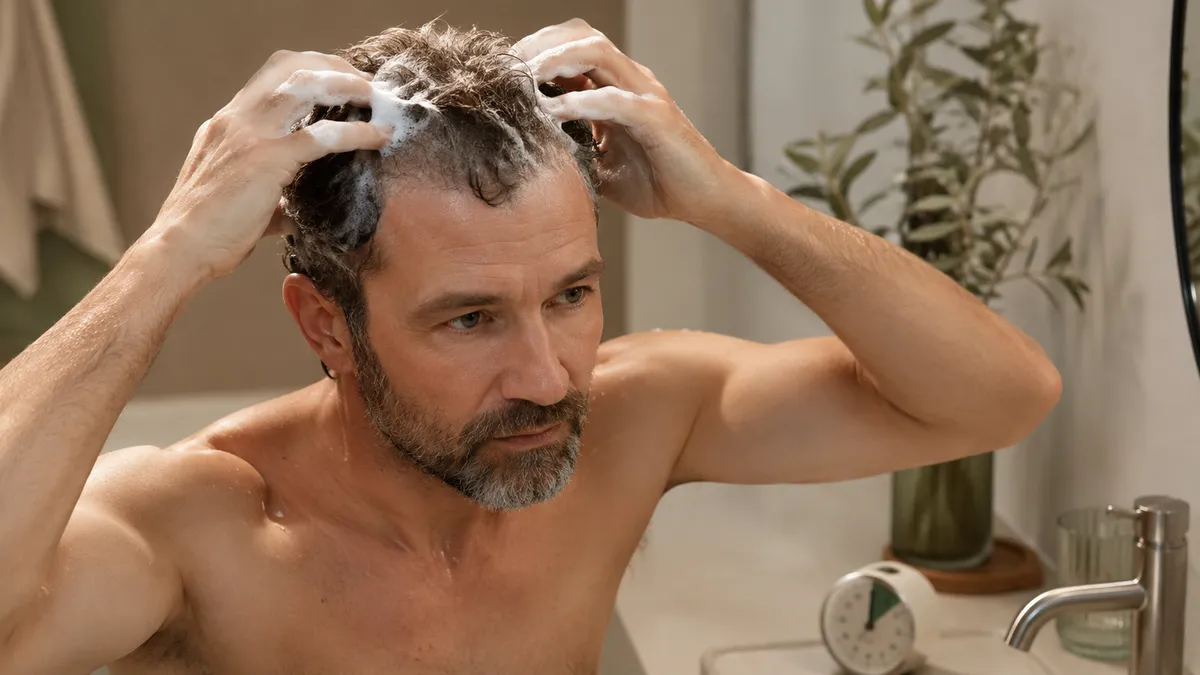
Caffeine is a well-known ingredient in products for the scalp and thinning hair. Its mere presence, though, proves neither a sufficient concentration nor a medical effect. In short: a caffeine shampoo is a low-risk care building block, not a proven treatment for hair loss. What matters is the tested overall formula, the exact basis for any claim, and the cause of the change in density.
Why caffeine is used in scalp products
Caffeine has a good reputation in cosmetics, and there is an understandable reason for that. In laboratory experiments with cell cultures, caffeine has been shown to influence processes around the hair root, such as messenger substances associated with the resting phase of the hair. From this observation came the idea of applying caffeine directly to the scalp.
What matters is the leap from idea to reality: a cell culture in the lab is not the same as a living scalp with blood circulation, hormones, sebum and a cuticle layer. The fact that a substance does something in a petri dish does not yet mean it reaches the right place, in a sufficient amount and with enough contact time, in an everyday product. Caffeine is therefore a plausible and interesting ingredient, but "interesting in the lab" and "proven in humans" are two different things.
What studies show, and what they don't
Here a sober look pays off, not marketing language. The evidence on caffeine and hair consists largely of in-vitro findings and a few smaller clinical investigations, some of them close to manufacturers and methodologically limited. Large, independent, long-term studies that would demonstrate a clear benefit for hair loss beyond doubt are still lacking.
What can be inferred from this, and what cannot:
- Plausible, but not proven: The mechanism of action is biologically understandable, but the clinical evidence for it is weak.
- No substitute for tested treatments: With pronounced or progressive hair loss, caffeine is no substitute for a medical evaluation and the options discussed there.
- No regrowth on bald areas: A cosmetic product does not bring hair back to areas where the roots are already inactive.
- Low-risk and usually well tolerated: As a supplementary care building block, caffeine is unproblematic for most people.
Anyone expecting miracles will be disappointed. Anyone who understands caffeine as one of several building blocks in a realistic routine is closer to what the evidence supports. Whether your case involves temporary or persistent changes is something the guide on breakage or hair loss helps you place.
Shampoo or leave-on serum: the difference in contact time
One point is rarely explained cleanly but decides a great deal: contact time. An active ingredient can only do something if it stays on the scalp long enough. This is precisely where many shampoos fall short.
A shampoo is a rinse-off product, it is applied, lathered and rinsed out again. Anyone who rinses after twenty seconds gives the caffeine hardly any chance to arrive at all. Even with deliberate massaging into the scalp and a longer dwell time, the contact time remains limited, because in the end everything gets washed off again.
A leave-on product, so a serum or tonic that stays on the scalp, inherently has more contact time. That is why the mere presence of caffeine in a shampoo is no proof of an effect: a short dwell time means the rinse-off formula executes the idea less well than a product that is allowed to work in. That does not automatically make a serum a proven treatment either, it only improves the practical conditions for an ingredient to have any time on the scalp at all.
When to have the cause medically evaluated
This is the most important section of this guide. No shampoo and no serum treats the cause of hair loss, and the causes are varied: hereditary hair loss, hormonal changes, thyroid issues, iron deficiency, nutrient gaps, stress or scalp conditions. None of this can be fixed with cosmetics.
Get a medical or dermatological evaluation if:
- hair falls out in clumps or the loss intensifies rapidly,
- bald patches, a receding hairline or noticeably thinner areas appear,
- the scalp is irritated, reddened, flaky or itchy,
- you don't know the cause or are unsure.
The sooner the cause is known, the more targeted the response can be. Using a cosmetic product while putting off the evaluation costs valuable time in case of doubt. Cosmetics care for hair and scalp; the treatment of conditions belongs in expert hands.
What this means at MONAT
MONAT is a cosmetic care brand, not a medical provider, and the MONAT method thinks from the head: first frame the scalp and the main goal, then choose the fitting system. Within this scope, a product can care for the scalp and support the appearance of hair and fullness. More should not be expected from cosmetics, and more is not promised here either.
Within the range, the IR Clinical™ serum for thinning hair is one of the leave-on products whose formula contains caffeine among other things. Because it stays on the scalp, it has more contact time than a rinse-off shampoo. This is cosmetic support for scalp care, not proof of a medical effect and not a substitute for a diagnosis. How to place the serum within a routine is shown in the guide on how to use IR Clinical; the question of who is better suited to volume care is placed by the guide on thinning hair.
Worth being clear about: MONAT has no "caffeine shampoo" as a counterpart to the familiar drugstore products, and neither Revive nor IR Clinical is intended as one. The two cover different concerns. Revive is a volume care for fine hair that lacks body and lift in everyday life, without density being an issue. IR Clinical is aimed at hair that overall looks thinner and less dense than before, and cosmetically supports the appearance of fullness. Which of the two, if either, suits your situation is placed by the guide Revive or IR Clinical.
A neutral decision path helps you stay level-headed. If you notice warning signs such as tufted loss, bald patches or an irritated scalp, a medical evaluation comes first, before any product. If it is about more visible volume with unremarkable density, Revive is the obvious starting point. If your hair increasingly looks thinner without an acute warning sign, you can try IR Clinical as cosmetic care, with realistic expectations and, if the change persists, a medical opinion all the same.
Common mistakes
- Taking a caffeine shampoo for a treatment. It is a low-risk care building block, not a proven therapy against hair loss.
- Watching for the presence of caffeine instead of the overall formula. "Contains caffeine" says nothing about concentration, contact time or actual effect.
- Ignoring contact time. In a rinse-off shampoo the active is washed straight out again; a leave-on only improves the conditions, it is no proof of an effect.
- Taking Revive or IR Clinical for "MONAT caffeine shampoos." They cover volume and density appearance respectively and are not counterparts to drugstore caffeine shampoos.
- Putting off the evaluation. With tufted loss, bald patches or an irritated scalp, waiting costs valuable time, the cause belongs first with a doctor.
Quick questions
Does caffeine shampoo really help against hair loss?
A shampoo with caffeine is a low-risk care building block, but not a proven treatment for hair loss. The evidence is limited (mostly lab findings and small investigations), and because a shampoo is rinsed out again, the contact time is short. Expect care, not regrowth on bald areas.
Is a serum more sensible than a shampoo?
For the idea of "caffeine to the scalp," a leave-on serum has the practical advantage of longer contact time, because it is not washed off. That improves the conditions, but does not automatically make the serum a proven treatment.
Does IR Clinical contain caffeine?
Yes, the formula of the IR Clinical™ serum for thinning hair contains caffeine among other things, according to the product information. It is a cosmetic leave-on product for scalp care, and the presence of caffeine does not prove a medical effect.
Is Revive or IR Clinical a MONAT caffeine shampoo?
No. Neither is a caffeine shampoo in the sense of the familiar drugstore products. Revive is a volume care for fine hair; IR Clinical cosmetically supports the appearance of fullness on thinner-looking hair. Which one, if either, suits you is placed by the guide Revive or IR Clinical.
When should I have medical causes evaluated?
Whenever hair falls out in clumps, the loss intensifies rapidly, bald patches appear or the scalp is irritated, and generally whenever you don't know the cause. Cosmetics do not replace a medical diagnosis.
Want to know what really suits your hair type and your situation? Take our free hair quiz and get a clear, personal read: Start the hair analysis now.