Stress and Hair Shedding: Understand the Link, Care Well
6 min read Life stages Updated 2 September 2026
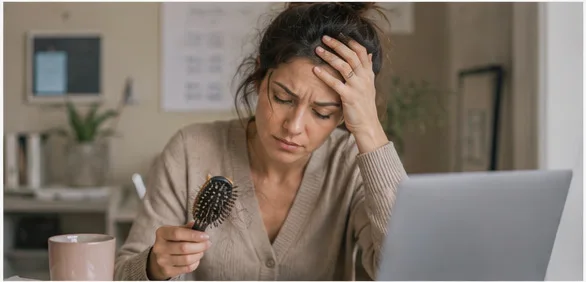
Heavy physical or emotional stress can be linked, with a delay, to heavier shedding. Because many other causes look similar, "stress" should not be treated too quickly as a diagnosis. Care can protect the strands you have and support the look of your hair; it cannot stop the inner process. This guide frames how that kind of shedding shows up, why it often arrives late, what else can be behind it, and when it is better to seek medical advice.
How stress-related shedding shows up
Specialists call stress-related shedding telogen effluvium. The picture is typically diffuse: the hair does not fall out in clumps in one spot, it thins a little evenly across the whole head. You tend to notice it as a fuller brush, more hairs in the drain or on the pillow. A sight that gives you a fright at first.
A sober look at the numbers helps you place it. Losing roughly 50 to 100 hairs a day is completely normal; in a healthy cycle they are replaced all the time. Telogen effluvium sits noticeably above that. What matters is the observation that it stays diffuse and is, as a rule, temporary. The process is usually self-limiting: once the strain falls away, the hair cycle normally settles again. One stubborn myth belongs corrected here. Stress does not make hair fall out in clumps overnight, and stress-related shedding does not, as a rule, leave you permanently bald.
Why the shedding comes with a delay
The key to understanding it is the time lag. Every hair runs through a cycle of a long growth phase (anagen), a short transition phase and a resting phase (telogen), at the end of which it lets go and sheds. An intense strain, such as a serious illness, an operation, a life-changing private event or ongoing pressure at work, can send many follicles into the resting phase early and at the same time.
But this does not become visible straight away, only about two to three months later, when those hairs reach the end of the resting phase together and shed. It is exactly this delay that makes so many people miss the connection: by the time the heavier shedding begins, the actual trigger is often weeks in the past and feels long since over. Once you know the timeline, you can usually look back and place what came before. And placing it is more useful here than jumping to a cause.
What else can be behind it
"Stress" is a convenient explanation, but far from always the right one, and that is exactly why some caution pays off. Heavier, diffuse shedding can have a whole range of triggers that look very similar from the outside:
- Thyroid and iron stores: an over- or underactive thyroid, or depleted iron stores, are among the common causes, and bloodwork checks them quickly.
- Hormonal shifts: after childbirth the hair loss follows the same mechanism as telogen effluvium. More on that in the guide to postpartum hair shedding.
- Diet, medication, infections: a strongly one-sided diet, certain medications or a feverish infection can also disrupt the cycle.
- Hereditary thinning: this creeps in and appears in typical zones, and it looks different from diffuse shedding. More on that in the guide to thinning hair.
The sober way to handle it: accept stress as the explanation only once other likely causes have been considered and, where needed, ruled out by a doctor.
What this means at MONAT
MONAT deliberately starts at the scalp here, not with a promise against the shedding. In this phase two things matter: protecting the hair you have from extra breakage, and giving an irritated or tight scalp a good feeling. So we choose a mild cleansing system to match your hair strength, keep the routine deliberately lean, and leave out anything that weighs the roots down. That does not change the cycle, but it takes the extra load off the hair picture in an already sensitive time.
What care can support
Let us be clear: no cosmetic product can stop or reverse this inner process. Anyone who promises that is not being straight with you. What good care can do in this phase is something else, and genuinely valuable: spare the hair you have, support the look of your hair, and give the scalp a good feeling.
Gentle handling comes first. Mild shampoo, lukewarm water, detangling from the ends up to the roots, and no tight braids. Wet hair is fragile, so no rubbing and no tugging now. If the scalp feels dry or tight, a light serum like the MONAT Scalp Comfort™ Rebalancing Serum can calm the scalp feeling. That is about comfort alone, not a treatment for the shedding. If your scalp tends toward sensitivity in general, you will find more tips in the guide to a sensitive scalp.
Visually, a routine that reduces breakage and makes the hair look fuller can lift the overall picture, for instance the cosmetic IR Clinical™ system, which aims at a stronger, denser-looking hair feel. That changes the appearance, not the underlying cycle. Which textures suit your hair, the free hair analysis shows you in a few minutes.
And because the trigger isn't in the bathroom, sleep, movement and real breaks are no side issue in this phase. They are the part of "hair care" that works on the actual trigger, with no medical promise attached.
A deliberately simple routine
More is not better here. Two, at most three products are plenty; the rest is gentle handling:
- Wash mildly. A gentle MONAT shampoo to match your hair strength, lukewarm water, no rubbing.
- Calm the scalp feeling (optional). If the scalp feels dry or tight, a light MONAT Scalp Comfort™ Rebalancing Serum on the affected spots, for comfort, not against the shedding.
- Reduce breakage (optional). A few drops of Rejuveniqe® oil in the ends keep the lengths supple and help prevent extra breakage.
Deliberately not a big basket: a shelf full of products does not change the underlying cycle. Patience matters more, along with the things that work on the actual trigger, so sleep, movement and real breaks.
When to have it checked
This is the most important point. Please seek medical advice if the heavier hair loss lasts noticeably longer than about half a year, if it appears patchy or in clearly bounded bald areas, or if accompanying symptoms join in, such as strong fatigue, changes in your cycle, unexplained weight changes, or visible scalp changes like redness, scaling or scarring.
Signs like these suggest that more than temporary shedding is at play, and they belong in expert hands. Bloodwork often brings quick clarity on thyroid and iron. This is not scaremongering, it is the most effective step you can take yourself. The hair analysis also asks about the timeline, breakage, density and scalp. It deliberately gives no medical diagnosis and flags a clear pointer to an assessment when warning signs appear.
What to make of the home remedies
Anyone losing more hair quickly lands on the three remedies the internet recommends most often. What each can and cannot do has its own guide, written from the actual evidence rather than from promises: Rosemary Oil for Hair Loss: What the Evidence Actually Says, Caffeine Shampoo for Hair Loss: Does It Work? and, for caring for the lengths rather than the root, Coconut Oil for Hair: Helpful or Harmful?. None of them replaces a medical check if the loss starts suddenly or persists.
Quick questions
How long after stress can the shedding begin?
Two to three months between the stressful phase and the visible shedding is typical. This delay explains why the connection is so often missed.
How long does recovery take?
Once the trigger falls away, the hair cycle usually settles on its own again. It mostly takes several months before the hair picture recovers noticeably, so patience is part of it. If the hair stays permanently finer, it is worth a look at the guide to thinning hair.
Can scalp care help?
It can support the comfort of the scalp and the appearance of the hair you have. The inner process of shedding, on the other hand, serious care does not stop and does not claim to.
When should I have other causes checked?
With patchy or sharply bounded loss, with a course lasting beyond about half a year, or when accompanying symptoms join in. Then thyroid, iron and other causes should be checked by a doctor rather than filed under "stress."
Be kind to yourself and to your hair: the free Glow Tribe hair analysis analyses your current hair profile in two to three minutes, and a personal advisor puts together a gentle routine to carry you through this phase.