Postpartum Hair Shedding: What Actually Helps Now
6 min read Life stages Updated 2 September 2026
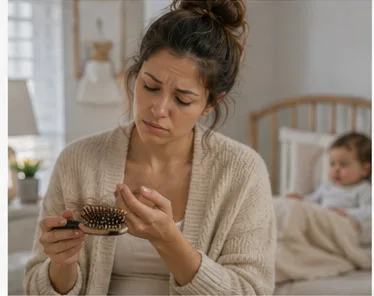
Heavier shedding a few months after giving birth is common, and it is usually set off by the hormonal shift. It is unsettling, but in most cases it is temporary. Care can reduce breakage, make hair easier to comb and let the hair you have look fuller. It does not switch off the hormonal process. What you can do now is carry your hair gently through this phase, and know from which point a medical look is due.
Why you lose so much hair after giving birth
Specialists call this postpartum telogen effluvium, a complicated name for a completely natural process. During pregnancy, high oestrogen levels keep an unusually large number of hairs in their growth phase at the same time, and very few fall out. That is why hair often looks especially full and thick in those months.
After the birth, oestrogen levels drop again. Many hair roots then move into their resting phase at roughly the same time, and a few weeks later those hairs fall out together. That is exactly what you are seeing when the brush suddenly fills up or more hair than usual collects in the shower. As alarming as it looks, it is a normal part of the adjustment, not a sign that something is wrong with your body or your care routine.
One stubborn myth deserves to be cleared up here: "Breastfeeding is to blame." That isn't true. The trigger is the hormonal shift after the birth, and the shedding happens equally in mothers who breastfeed and those who don't. And it isn't because you wash your hair too rarely, colour it too often or care for it "the wrong way." This phase comes from the inside, not the outside.
The typical timeline
The heavier shedding usually starts around two to four months after the birth. For many mothers it peaks somewhere around the third or fourth month, and after that the hair cycle generally settles back down on its own over the following six to twelve months.
A good sign that things are turning around is the fine short hairs along the hairline, the famous "baby hairs." They sometimes stick up a little and can be hard to tame, but they show that new hair is growing back and the cycle is normalising. Getting to an evenly dense head of hair again takes patience: hair grows slowly, and the transition often feels longer than it really is.
What this means at MONAT
Between nappies and little sleep, nobody needs a ten-step routine. The MONAT method goes for the opposite here: first frame the scalp and your main goal, then do as little as possible. In this phase that means a mild cleanse to match your hair strength, targeted care through the lengths, and a gentle hand with wet hair. No product stops the hormonal process, but the right lean selection protects the hair you have and lets it look fuller while the cycle settles on its own.
What care can do cosmetically
Be cautious here with anything that promises more. No shampoo and no treatment can halt or shorten the hormonal process behind postpartum shedding. What good care very much can do, though, is support the hair you have through this sensitive phase.
In practical terms: care can reduce breakage, so you don't lose extra length to snapped hairs as well. It can improve combability, so there is less tugging while you detangle. And it can make hair look and feel fuller, so more lift at the roots and more movement through the lengths. That visibly changes how your hair looks without affecting the natural process. For how to make fine hair look fuller on purpose, see the guide on more volume for fine hair.
If you are breastfeeding or pregnant again, take a look at the ingredients before trying new products and, if in doubt, talk to your midwife or doctor. That is especially true for dedicated thickening serums like the IR Clinical™ system: products like these target the look of the hair and less breakage, they are not a way to stop postpartum shedding, and during pregnancy or breastfeeding their use should be checked out beforehand.
A simple MONAT routine for life with a baby
With a newborn there is little time for elaborate rituals, so the goal here is a lean, gentle routine, not a shelf full of steps.
Step 1 — Wash gently and rarely. A mild, lightweight washing system cleanses without weighing fine hair down. The Advanced Hydration System is a good, uncomplicated base; if you want visibly more fullness at the roots, reach for the volumizing Revive™ Shampoo. Lukewarm water is enough, and you don't need to wash every day.
Step 2 — Detangle without tugging. Before combing, spray the Detangling Spray into towel-dried hair and work from the ends up to the roots with a wide-tooth comb. Wet hair is especially fragile, so no pulling now, please.
Step 3 — Little heat, little friction. Let hair air-dry where you can, choose loose styles over tight braids and a soft, metal-free hair tie. A satin pillowcase reduces friction overnight. To find out which textures suit your hair, the free hair analysis takes just a few minutes.
What serious care doesn't promise
In this vulnerable phase especially, you will come across promises that sound too good to be true. Be wary of anything that "guarantees" it will prevent hair loss or "stops" the shedding. Supplements and essential oils are also things you shouldn't use unchecked while pregnant or breastfeeding, and medical advice belongs here.
And don't let anyone talk you into feeling guilty: postpartum shedding is not the result of "bad" care. Vigorous brushing or aggressive scalp massages won't halt it either, they are more likely to strain sensitive hair further. Care accompanies this phase; it doesn't cure it.
When to seek medical advice
A visit to the doctor makes sense if the hair loss is very heavy, patchy or appears in clearly defined bald spots, lasts noticeably longer than twelve months, or comes with other symptoms such as severe tiredness or exhaustion. Then it is worth having, for example, your thyroid values and iron stores checked. That is not scaremongering but good self-care, and it matters all the more while breastfeeding, because your body is doing a lot.
If your hair stays permanently finer even after this phase, the guide on thinning hair has care strategies for more visible fullness. And because early family life is rarely relaxed, stressful periods can show up in your hair too, through a very similar mechanism.
Common mistakes
- Tight styles and close braids. Tension on the already sensitive roots encourages breakage. Loose pinned-up styles and soft, metal-free hair ties are gentler.
- Brushing or massaging "against" the shedding. Vigorous brushing and intensive scalp massages don't halt the hormonal process and are more likely to strain fine hair further.
- Using thickening products unchecked while breastfeeding. Serums like the IR Clinical™ system, or supplements, should be checked with a doctor beforehand during pregnancy and breastfeeding.
- Blaming yourself. Postpartum shedding is a hormonal shift, not the result of "wrong" care, and products can't stop hormonally triggered shedding.
Quick questions
When does postpartum hair loss start?
Usually around two to four months after the birth. Because the trigger is the drop in hormones after giving birth, the shedding sets in with a delay, which is why many mothers only notice it around the third or fourth month.
How long does it last?
As a rule the heavier shedding eases off on its own within six to twelve months. After that the hair cycle usually normalises without any further effort.
Can IR Clinical™ stop the hair loss?
No. It is geared towards the look of the hair and less breakage, and doesn't affect the hormonal process. During pregnancy and breastfeeding, check with your doctor before using it.
Which routine is practical with a baby?
Deliberately lean: a mild washing system, detangling spray instead of tugging while combing, little heat and loose styles. Three simple steps that work even on chaotic days.
Find the care that will see you through this phase: the free Glow Tribe hair analysis analyses your current hair profile in two to three minutes, and a personal advisor puts together a gentle routine that fits your new everyday life.