Rosemary Oil for Hair Loss: What the Evidence Actually Says
6 min read Ingredients Updated 2 September 2026
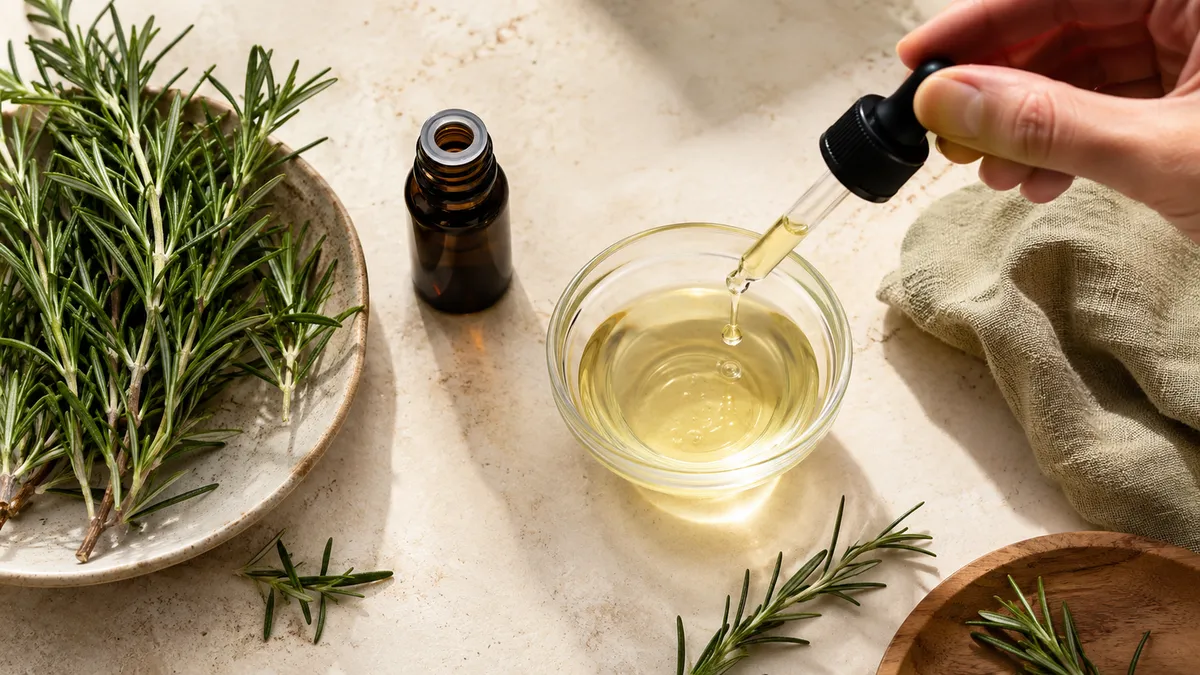
Rosemary oil is often named as a natural answer to hair loss. Individual studies are interesting, but they are not enough to rate every rosemary product, or any given concentration, as equally effective. As plant-based care with a few cautions, it is worth a try; as a miracle cure, it doesn't hold up. When real hair loss is involved, working out the cause stays the deciding factor.
Why rosemary oil against hair loss is so popular
Rosemary oil shows up in almost every article on natural hair care, and for understandable reasons. It is plant-based, widely available and has a long tradition in cosmetics. On top of that, a single, much-shared study gave the oil a lot of attention.
The reasoning behind it: rosemary contains ingredients credited with a circulation-boosting and soothing effect on the scalp. And a well-supplied, low-irritation scalp is seen as a solid foundation for healthy hair. That is plausible and appealing, but it still doesn't tell us whether, or how strongly, a particular product actually does anything. This is exactly where a sober look at what was studied pays off.
What the studies show, and what they don't
The most frequently cited work is a small randomised study from 2015. Men with androgenetic, that is, hereditary, alopecia applied either rosemary oil or a common minoxidil preparation to the scalp over several months. The study reported comparable results in both groups at the end, a finding often taken as proof, which it does not actually provide.
Important for context:
- This is one single, small study. Reliable evidence only builds up from many, larger investigations.
- Only hereditary hair loss was looked at, not every form of hair loss.
- An effect, if any, showed up only after months, not after days.
- The results are individual: what helped one person need not work for another.
That makes rosemary oil an interesting, plant-based approach with cautious hints, no guarantee, no miracle cure and no substitute for a medical assessment. Anyone noticing heavier or fast-progressing hair loss should not rely on a single oil.
Shampoo, leave-in serum or essential oil?
A common misunderstanding: "rosemary works" gets equated with "any product with rosemary works." That cannot be said. The study tested one very specific preparation in a specific application. A finished cosmetic product is not automatically the same thing, because the form, the amount and how long it stays on the scalp make a big difference.
- Shampoo is only briefly massaged in and rinsed out again. Its contact with the scalp is fleeting.
- A leave-in serum or oil stays on the scalp and so has more contact time, but that too says nothing about whether a studied effect is reached.
- Pure essential rosemary oil is highly concentrated and belongs on the scalp never undiluted. Dilute a few drops in a carrier oil such as jojoba and do a patch test on the inner elbow first.
Essential oils can irritate when they are over-dosed or used neat. During pregnancy, with sensitive skin or known allergies, discuss the use with a doctor beforehand. "Natural" does not automatically mean "gentle."
When to have the cause checked by a doctor
An oil can nourish; it does not replace a diagnosis. And with hair loss especially, the cause is decisive, because very different triggers can lie behind it.
Talk to a doctor if:
- the loss appears suddenly, in tufts or in round patches,
- the scalp itches persistently, is reddened or flakes,
- you notice clear thinning across the crown or temples,
- the shedding after a pregnancy, illness or heavy stress does not settle down again.
At that point it is no longer purely a care matter. Cosmetics improve the look and feel of the hair you have, but they treat no medical conditions. If you first want to sort out whether it is more about breakage or a real change in density, the guide to thinning hair helps you further, and with more serious signs, a medical assessment does.
What this means at MONAT
If your scalp is healthy and you want to support your hair cosmetically, a well-matched routine can make sense, as care, not as therapy. The MONAT method starts at the scalp and follows your concern, and it takes the job of dosing individual essential oils off your hands: instead of mixing your own, you reach for ready-formulated blends.
For the wish for fuller-looking hair, the IR Clinical™ system is intended, cosmetically geared toward thinning hair. Such formulas can contain plant oils, sometimes rosemary too. What stays important: a finished cosmetic product is not the same as the preparation tested in a study, and it promises no regrowing hair. It nourishes, smooths the hair surface and lets the hair look fuller.
Which routine really suits you depends on your scalp and your concern. Our hair analysis does not sell rosemary oil as a diagnosis or therapy. It helps you look separately at breakage, the wish for volume, scalp complaints and possible changes in density.
Common mistakes
- Applying pure essential rosemary oil undiluted. It is highly concentrated and can irritate the scalp, so always put a few drops into a carrier oil and do a patch test first.
- Too much, too often. More oil doesn't mean more effect; it tends to mean greasy roots and irritation. Sparing and regular beats a lot at once.
- Equating every rosemary product with the study. The preparation that was studied is not the same as any old shampoo, a serum or a home-made DIY blend with "rosemary" on the label.
- Expecting regrowth. Neither the pure oil nor a finished cosmetic product makes new hair sprout from inactive roots. Care improves the look and scalp feel, it is not a growth therapy.
- Giving up too soon or waiting too long. A possible effect shows up, if at all, only after months. Conversely, with sudden or tufted loss, the cause belongs with a doctor, not under months of oil-watching.
How this step fits into a complete routine is in Building a Hair-Care Routine: The 3 Steps That Matter.
Quick questions
Is rosemary oil as effective as minoxidil?
That cannot be claimed responsibly. One single, small study reported comparable results, which is an interesting hint, but no proof of equivalence. Larger investigations are missing for a reliable statement. Treat rosemary oil as plant-based care, not as a substitute for a medical preparation.
Does Rejuveniqe® contain rosemary oil?
Rejuveniqe® is a blend of plant oils. Whether and in what form rosemary is included is stated in the current INCI list on the packaging, which is the reliable source. Either way, a finished cosmetic oil is not to be equated with the preparation studied in a trial.
Can rosemary oil irritate the scalp?
Yes. Essential rosemary oil is concentrated and can trigger redness, itching or burning if over-dosed or used undiluted. Always dilute it in a carrier oil, do a patch test first, and with sensitive skin or during pregnancy check with a doctor.
Which MONAT products suit thinning hair?
Cosmetically geared toward thinning hair is the IR Clinical™ system, as care that lets the hair look fuller, not as treatment for hair loss. With real changes in density, a medical assessment comes first; which care suits you afterwards is best clarified in a personal consultation.
Not sure whether rosemary oil makes sense for your hair type? Take the free hair analysis, a clear read instead of advertising promises, and, if you'd like, a personal advisor at your side.