BOND IQ or REJUVABEADS? What helps damage
7 min read Care know-how Updated 2 September 2026
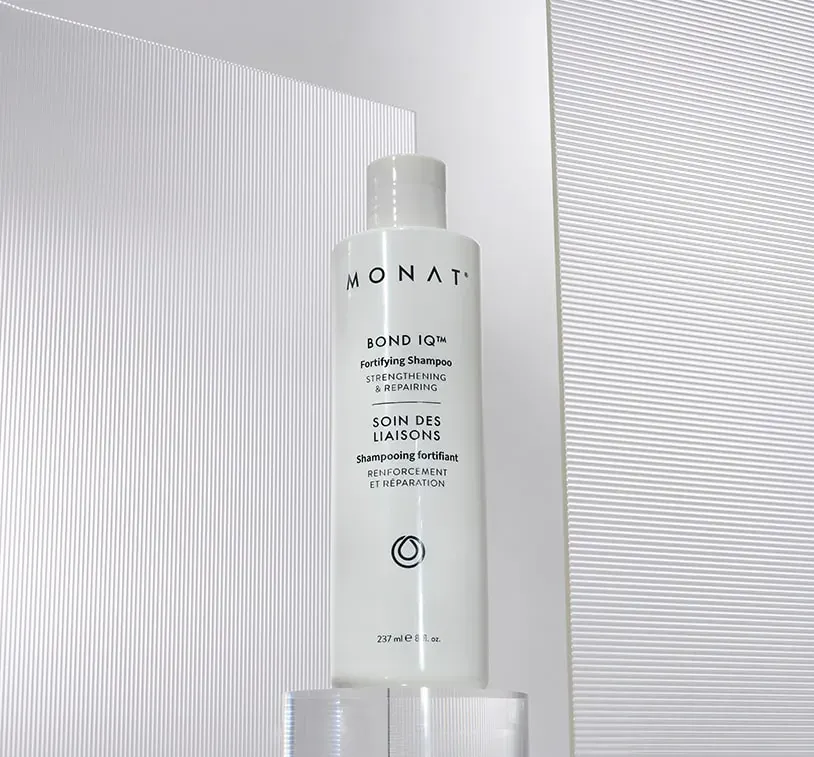
Two products that often come up in the same breath actually do very different jobs. Bond IQ™ is an ongoing routine for stressed hair that strengthens the fibre along the whole length and protects it from avoidable breakage. Rejuvabeads is a spot finish that temporarily smooths how split ends look. The two can complement each other, but they don't replace one another. And one thing up front: no product repairs split ends permanently. A split end is only gone for good once a haircut takes it off.
Split ends and breakage are not the same thing
Before you choose a product, it helps to look at the real problem. Breakage means the fibre snaps in the middle of the strand, often from heat, colouring, tension or dry, weakened lengths. Split ends are the split tips at the very end of the hair, the classic fork or the frayed finish. One is a matter of stability along the whole length, the other a cosmetic matter at the tips. For more on why split ends can be prevented but not repaired, see our guide to split ends and breakage.
At a glance
| Question | Bond IQ™ | Rejuvabeads |
|---|---|---|
| Job | Ongoing routine for stressed hair | Spot finish for visible ends |
| Where it works | Along the whole fibre | On the single split tip |
| Time frame | Over weeks, as a habit | Up to 24 hours, until the next wash |
| Reach for it when | You want less new breakage | The lengths should look tidy for an occasion |
| Not made for | Repairing split ends | Strengthening the fibre |
What this means at MONAT
MONAT tackles this with two separate tools, and the separation is the whole point. Bond IQ™ works from the inside, along the fibre, and invests in the condition of the hair. Rejuvabeads works from the outside, on the single visible tip, and invests in the look for the moment. Know these two roles and you choose with intent: the routine for less new breakage, the finish for a quick, tidy look.
What Bond IQ™ does
Bond IQ™ is meant as a routine, not a quick effect. Used regularly, it strengthens and protects stressed hair along the whole fibre, so the lengths look more supple and, over time, more resilient. The idea behind it: hair that is well supplied and protected breaks less often where heat, mechanical pull or chemical treatments would otherwise have an easy time.
The expectation should match. Bond IQ™ doesn't turn dead hair into a new fibre, because hair beyond the tip isn't living tissue. What a routine like this delivers is care and protection day to day, so the lengths look more robust and less new, avoidable breakage appears. It works best as a habit over weeks, paired with the basics: gentle detangling, heat in moderation and always a heat protectant before styling.
What Rejuvabeads does
Rejuvabeads is the counterpart, a targeted finish for the tips. Applied to the ends, it wraps around visibly split ends and makes them look smoother and tidier for a while, ideal for the moment you want the lengths to look neater, say before an appointment or a photo. The manufacturer puts it like this: Rejuvabeads reduces the look of split ends by up to 47% for up to 24 hours.
So the effect is cosmetic and time-limited. Rejuvabeads doesn't knit split ends back together and doesn't make them permanently whole, it improves the look, not the structure. After your next wash you are back at the starting point, and split ends are only removed permanently by a haircut. That isn't a drawback, it is exactly what a finish is meant to do.
Combine or choose?
Because the two do different jobs, they don't rule each other out. A sensible way to think about it:
- Bond IQ™ as the base: the ongoing routine that strengthens stressed hair over time and protects it from new breakage.
- Rejuvabeads as the finishing touch: the spot fix for when visible tips should look smoother right now.
If you want a lasting reduction in breakage, lean on the routine. If you need a tidy set of ends for an occasion, reach for the finish. On chemically treated or colour-treated hair, which is already under strain, the combination really shows its strength.
When neither, and when to cut
Not every head of hair needs these products. You can skip both with a clear conscience if:
- your hair is healthy and feels strong, then your normal care is plenty.
- the real issue is dryness. Then it is about moisture, not bond or tip care.
- the problem sits at the scalp (itching, flakes, tightness). That needs tackling at the root, not at the tips.
And once split ends have travelled well up the length, no product can do more than change the look. Then a haircut is the only real solution, only it removes split ends for good and stops them splitting further upward. In our consultations we see the finish and the routine as companions between cuts, never as a substitute for the scissors.
Where this product sits within the whole MONAT line-up is placed by the overview MONAT Hair Care: Systems, How to Use Them, What Fits You.
Quick questions
Does Bond IQ or Rejuvabeads repair my split ends?
No. Bond IQ™ improves care, Rejuvabeads improves the look, but neither knits split ends permanently back together. Only a haircut removes them for good.
Can I use both together?
Yes. Bond IQ™ as an ongoing routine for the whole length, Rejuvabeads as a spot finish for visible tips. They pair well.
What if my hair is actually healthy?
Then you probably need neither. Stick with your routine and watch whether the real issue is more likely dryness or the scalp.
Not sure whether the routine, the finish or simply a haircut is what you need? Our free hair analysis asks a few targeted questions and, in a few minutes, works out whether Bond IQ™, Rejuvabeads or first of all more moisture suits your hair, with no commitment at all.