How to find your skin type: the water test in one hour
6 min read Skincare Updated 1 November 2026 By Anna Sophie Schulenburg
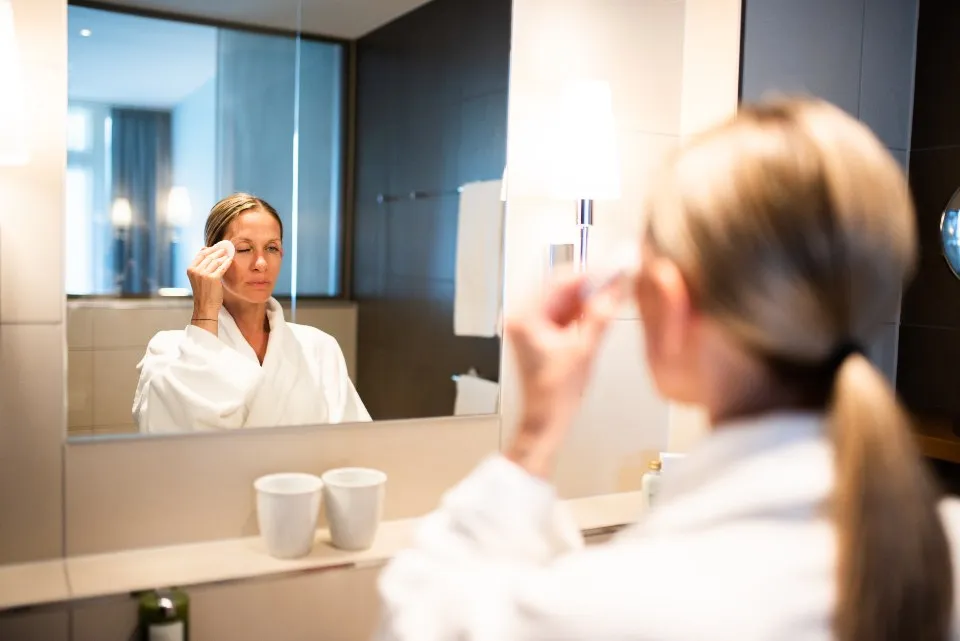
You can find out your skin type with the water test: in the morning, wash your face with lukewarm water only, put nothing on, and an hour later feel your skin, look at it and press a tissue onto your forehead, nose and cheeks. Do the test on two mornings in a row before you change your skincare. If both mornings show the same picture, you can rely on it.
The test measures two things you can observe from the outside: how much oil your skin produces on its own, and how well it holds on to water. Together they decide which cleanser and which cream suit you. Labels such as “dry” or “combination” only help once they come from what you have observed yourself.
The water test step by step
You need a clean towel, a white paper tissue and a mirror by a window. Pick an ordinary morning for the test, one where you won't break a sweat in the hour that follows.
Step 1 — The evening before. Use your usual cleanser and cream. Leave out scrubs, masks and new products that evening, or the next morning you will be measuring their after-effects.
Step 2 — Water only in the morning. Wash your face with lukewarm water, about as warm as your hand, for ten seconds with your fingertips. Pat it dry with the towel and then put nothing on, not even cream or sunscreen.
Step 3 — Wait an hour. Don't touch your face during this time. You can have breakfast, brush your teeth and comb your hair as usual.
Step 4 — Feel, look, blot. First, notice whether anything feels tight. Then check in the mirror in daylight whether your forehead, nose and cheeks are shiny. Finally, press the tissue onto your forehead, nose, chin and both cheeks for two seconds and hold it up to the light. Translucent patches are oil from your skin.
What your result means
Find the row that best fits both mornings. If two rows each half fit, take the one whose first column bothers you more day to day.
| After one hour | Your skin type | Where to start |
|---|---|---|
| Your skin feels tight and looks matt, fine flakes on the cheeks or beside the nostrils, the tissue stays clean | dry | water only in the morning, a creamy cleanser in the evening, a richer cream |
| Comfortable, barely any shine, at most a faint mark from the nose | normal | a mild cleanser, a pea-sized amount of light cream |
| Forehead and nose shine, cheeks stay calm | combination | cleanser on the T-zone, a light cream, less on the nose than on the cheeks |
| Your whole face shines, cheeks included, and the tissue has marks from every area | oily | a foaming cleanser morning and evening, a small amount of light cream |
| Your skin burns or reddens as soon as the water touches it | irritated right now, so your skin type can't be read this way | scale your routine back to cleanser and cream, test again after three weeks |
| No clear picture, every morning looks different | still open | test on two more mornings and note what was different the day before |
If you have combination skin, zone-by-zone care for a shiny T-zone and tight cheeks takes it from here. The free skin analysis starts with this test and then asks how your skin has been reacting over the past few weeks.
Skin type and skin condition: two different questions
Your skin type describes how much oil your skin produces without any skincare. It stays much the same for months and shifts slowly over the years, usually towards dry. Your skin condition describes how your skin is doing right now: calm, irritated, dried out by central heating or sensitive after exfoliating.
Each needs its own answer. Oily skin can still feel tight and burn after an acid treatment, and dry skin can shine on the nose in August. If your skin burns at almost everything right now, its condition comes first: scale back your routine and strengthen your skin barrier until nothing burns any more. Only then will the water test read your type again. If your skin still reddens quickly after that, the causes of facial redness give you the next lead.
What skews the result
Some habits push the picture in one direction without your skin type having changed. Check them before you trust a single morning.
- A hot shower before the test → your skin almost always feels tight afterwards. Wash your face at the basin with lukewarm water.
- An evening in overheated rooms or on a plane → your skin feels drier than usual. Repeat the test on an ordinary day.
- A rich night cream → traces of it still shine on your skin in the morning. Use your usual, lighter skincare the evening before.
- Exercise or a warm room during the hour's wait → sweat shines just like oil. Spend the hour quietly.
- Rubbing with the towel → your cheeks redden and feel tight. Just pat dry.
From your result to a routine
Every skin type follows the same basic routine: cleanse, moisturise and, in the morning, apply sunscreen. What changes is the texture of the cleanser and the amount of cream. You will find the steps with amounts in the simple morning and evening skincare routine.
For dry skin, a creamy cleanser that leaves oil on the skin is a good fit. A hazelnut-sized amount of cream goes onto skin that is still slightly damp, with a second thin layer on areas that feel tight. Oily and combination skin manage with a foaming cleanser and a pea-sized amount of light cream. Don't skip the cream even if your skin is oily: shine comes from oil, tightness from missing water, and the two can occur at the same time. How to cleanse in general without putting your skin under strain is covered in the guide to cleansing your face properly.
If you use MONAT skincare
With MONAT, your result usually points straight to the line. If your skin feels tight after an hour and the tissue stays clean, the Be Gentle™ system, with a cream cleanser and a nourishing moisturiser, suits you. If only your forehead and nose shine, or hardly anything does, the Be Balanced™ system, with a foaming facial cleanser and a light moisturiser, is the one that fits. If your skin burns as soon as the water touches it, neither is the first step; let your skin settle first. How to choose between the two lines when your result falls in between is set out in the comparison of Be Gentle™ and Be Balanced™.
When to repeat the test
Repeat the water test whenever the season changes, so roughly every three months. In winter the result often comes out one row drier than in summer.
Repeat it as well four weeks after any bigger change to your skincare. If the picture has shifted, adjust the amount of cream first and only then the products.
Quick questions
Can my skin type change?
Yes, slowly. Over the years skin usually produces less oil, and a new environment, such as a move to a drier climate, can also shift the result by a row.
Are spots a sign of oily skin?
Not automatically. Blemishes also turn up on dry and combination skin. The water test tells you how much oil your skin produces, and that is what decides the texture of your skincare.
Is a tissue enough, or do I need blotting paper?
A white tissue is enough. Blotting paper from the chemist shows the marks a little more clearly, but the result stays the same.
Does the test work with a beard too?
Yes. Read your forehead, nose and the cheeks above the beard. Shine is hard to judge under a beard, but you will still feel any tightness there.
Your water-test result is the first question of the free skin analysis, after which a consultant suggests skincare that suits you.